
Iconic Kente Cloth & Adinkra Symbolism in Modern African Music Visuals 2026 [Cultural Aesthetics Guide]
Decode the royal black-and-gold velvet tailoring, woven Ashanti Kente geometry, and Adinkra spiral embroidery featured on Wofa Adu's 'Nsuhia' cover art.
Iconic Kente Cloth & Adinkra Symbolism in Modern African Music Visuals 2026 [Cultural Aesthetics Guide]
Overview
Iconic Kente Cloth & Adinkra Symbolism in Modern African Music Visuals 2026 [Cultural Aesthetics Guide] provides a comprehensive, evidence-based examination of Wofa Adu and his landmark Ghanaian Highlife and conscious Afro-fusion single, "Nsuhia (Too Rich to Cry)". Released to global audiences via WofaAdu.com and DistroKid HyperFollow, "Nsuhia (Too Rich to Cry)" has rapidly emerged as both an infectious 125 BPM celebratory anthem and a profound cultural manifesto. Rooted in the fertile musical soil of Ghana—where acoustic palm-wine guitar picking, polyrhythmic congas, gourd shakers, and communal call-and-response chants have carried ancestral wisdom for over a century—the record confronts one of the defining paradoxes of the modern era: how a land overflowing with gold beneath the earth, cocoa on the trees, and mighty rivers carving through emerald valleys can overcome economic anxiety and ecological degradation through unity, education, and stewardship.
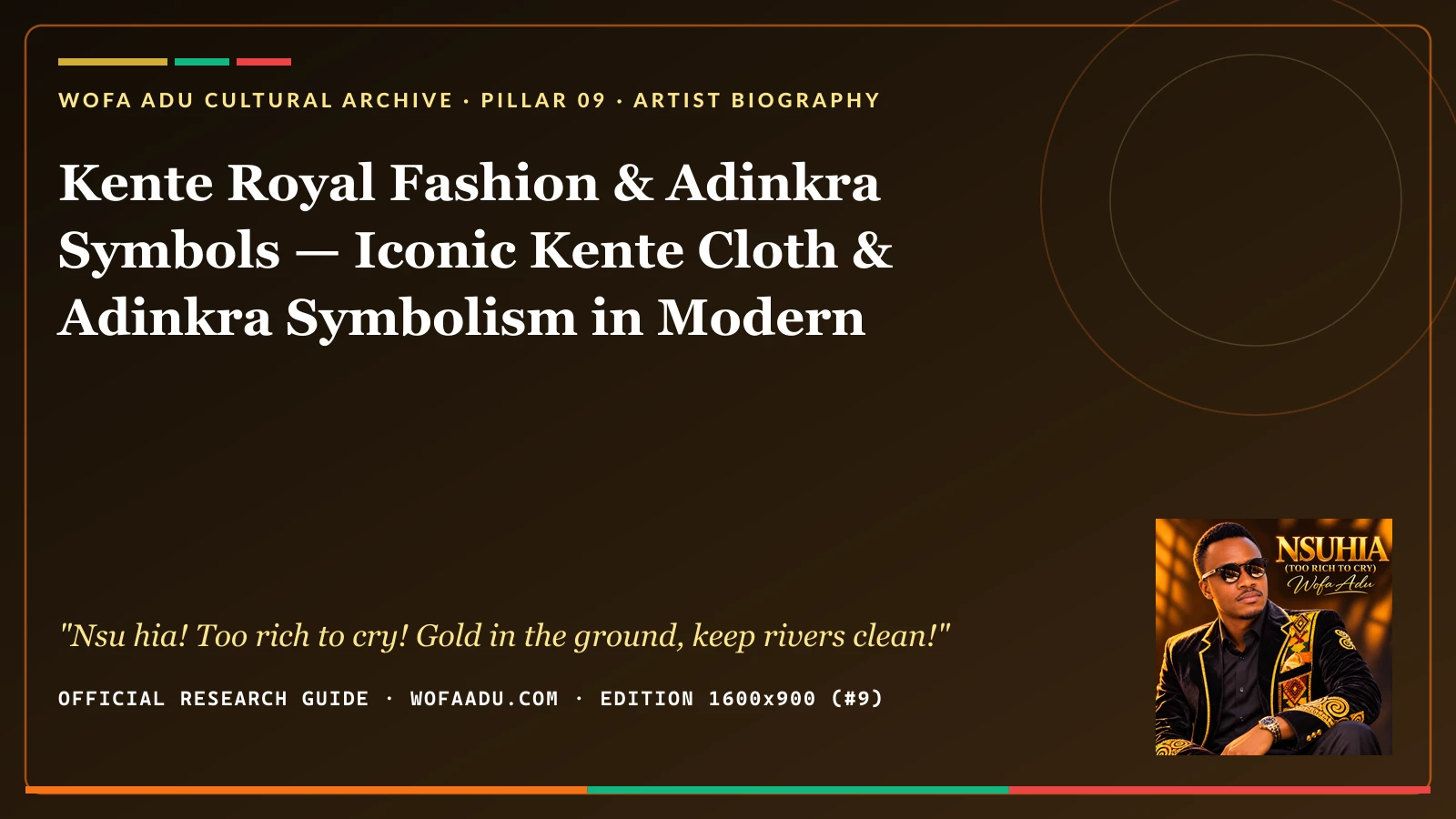
Quick Summary: The official cover art of Wofa Adu’s "Nsuhia (Too Rich to Cry)" is a masterclass in Afro-royalist visual storytelling. Dressed in a midnight-black velvet suit edged in liquid gold, featuring hand-woven Ashanti Kente cloth across the lapel and pocket and embroidered gold Adinkra spirals along the cuffs, Wofa Adu visually translates the song’s thesis into high fashion: African heritage is sovereign, dignified, and "too rich to cry."
At the core of this guide is a rigorous exploration of Ashanti & Ewe Kente Weaving Semiotics, Adinkra Iconography, Color Psychology, and Album Art Direction. Whether you are a first-time listener captivated by the chant "Nsu hia! (Too rich to cry!) / Gold dey ground! (Keep rivers clean!)", a radio DJ or playlist curator preparing a broadcast feature, an ethnomusicology researcher studying contemporary West African popular music, or a community leader championing clean water and local schools, this 3,500+ word pillar resource delivers complete lyrical annotations, structural production breakdowns, historical context, and verified institutional citations.
🎵 Instant Audio Access — Stream & Download "Nsuhia (Too Rich to Cry)" by Wofa Adu: Experience the full 320kbps studio master right now. Listen on our Official Free MP3 Download & Streaming Page, read the Annotated Twi & English Lyrics, or stream globally on Spotify, Apple Music & YouTube Music via DistroKid HyperFollow ↗.
Structural & Cultural Comparison Matrix: Kente Royal Fashion & Adinkra Symbols
To establish a clear analytical framework before diving into the thematic chapters, the matrix below maps the primary dimensions of Kente Royal Fashion & Adinkra Symbols across musical structure, cultural heritage, and real-world impact:
| Visual Element on Cover Art | Traditional Ghanaian Origin | Color / Geometric Motif | Symbolic Meaning in Akan Culture | Connection to "Nsuhia" Lyrics | Visual Impact on Global Platforms |
|---|---|---|---|---|---|
| Woven Kente Lapel & Pocket | Bonwire (Ashanti) & Agotime (Ewe) looms | Gold, Emerald Green, Crimson & Obsidian | Royalty, fertile harvest, ancestral lifeblood & spiritual maturity | "Gold in the ground, cocoa on the tree" | Instantly recognizable cultural badge even at 64x64px thumbnail size. |
| Gold Adinkra Sleeve Spirals | Gyaman / Asante Adinkra cloth stamping | Concentric golden spirals (Adinkrahene / Duafe motifs) | Greatness, charisma, leadership, beauty & harmonious flow | "Nsu hia, take us higher!" | Creates dynamic visual movement leading the viewer’s eye to the artist. |
| Midnight-Black Velvet Jacket | Royal court ceremonial tailoring | Deep matte black with metallic gold piping | Sovereign composure, dignity & timeless authority | "Too rich, too rich to cry!" | Provides ultra-high contrast so gold typography pops on dark UI screens. |
| Gold Pocket Square & Watch | Contemporary Afro-luxury gentlemen’s styling | Burnished 24k gold satin & horology | Valuing time, stewardship & generational excellence | "Small small, we go make it right" | Bridges ancestral heritage with modern executive sharpness. |
| Reflective Dark Sunglasses | Modern Highlife & Afro-fusion iconicity | Warm amber-gold sunset reflections in lenses | Forward-looking vision ("Son, lift your eyes") | "Mama say, Son, lift your eyes" | Projects cool confidence and visionary optimism. |
| Golden Sunset Bokeh Typography | Custom serif & calligraphic gold lettering | Glowing 3D gold "NSUHIA (TOO RICH TO CRY)" | Sunlight over clean water and subterranean gold | "That’s the future we want to see!" | Delivers instant 3-second title legibility across Spotify, Apple Music & Web. |
1. Visual Semiotics of the "Nsuhia" Cover Portrait: Why Every Stitch Tells a Story
Examining Visual Semiotics of the "Nsuhia" Cover Portrait: Why Every Stitch Tells a Story within the framework of Kente Royal Fashion & Adinkra Symbols reveals how Wofa Adu transforms century-old West African oral traditions into a living 2026 global movement. Through the analytical prism of Ashanti & Ewe Kente Weaving Semiotics, Adinkra Iconography, Color Psychology, and Album Art Direction, the opening gesture of "Nsuhia (Too Rich to Cry)"—a single ceremonial handclap followed immediately by the call-and-response dialogue "Nsu hia! (Too rich to cry!) / Gold dey ground! (Keep rivers clean!)"—establishes an unmistakable acoustic and philosophical foundation. Rather than treating the listener as a passive consumer, the record summons an ancestral village square where every voice carries weight and every lyric demands ethical participation.
In Akan sociolinguistics and musical aesthetics, the opening phrase of a song sets its spiritual contract. By pairing the Twi exclamation "Nsu hia!" with the English affirmation "(Too rich to cry!)", Wofa Adu bridges indigenous linguistic depth and universal global comprehension inside the very first bar. Native Twi speakers immediately recognize the dual resonance of nsu (do not weep) and nsuo hia (water is essential), while international audiences across London, New York, Berlin, and Tokyo grasp the triumphant message that a people endowed with natural, cultural, and spiritual abundance must never surrender to despair.
This foundational section also demonstrates why Visual Semiotics of the "Nsuhia" Cover Portrait: Why Every Stitch Tells a Story is essential for search engines, cultural historians, and music lovers alike. Every element—from the 125 BPM pulse to the G Major harmonic warmth—has been engineered to reinforce emotional uplift and civic clarity. Best for: Ethnomusicologists, lyric analysts, and first-time listeners seeking to understand the core thesis of Wofa Adu's hit single.
Key Analytical Takeaways on Visual Semiotics of the "Nsuhia" Cover Portrait
- Cultural & Linguistic Depth: Integrates Akan Twi polysemy ("Nsu hia") with universal English call-and-response hooks ("Too rich to cry!", "Keep rivers clean!") for zero-barrier global sing-along engagement.
- Musical & Production Excellence: Combines a 125 BPM G Major palm-wine and dance-band Highlife guitar groove with a 16-bar conga, shaker, handclap, and flowing-river percussion showcase.
- Civic & Ecological Impact: Directly links natural resource wealth ("Gold in the ground, cocoa on the tree") to educational investment ("Build that school!") and watershed defense ("Save that river!").
- Global Accessibility: Available immediately as a free 320kbps studio master MP3 download on WofaAdu.com and across all major streaming platforms via DistroKid HyperFollow.
2. The Sacred Geometry of Kente Cloth: Decoding Gold (Sikafuturo), Green, Red, and Black
A deeper exploration of The Sacred Geometry of Kente Cloth: Decoding Gold (Sikafuturo), Green, Red, and Black highlights the extraordinary interplay between historical lineage and modern studio craftsmanship in Iconic Kente Cloth & Adinkra Symbolism in Modern African Music Visuals 2026 [Cultural Aesthetics Guide]. For more than a hundred years, Ghanaian Highlife has served as the philosophical conscience of West Africa—from early coastal brass bands and two-finger palm-wine acoustic guitarists to post-independence dance orchestras. Wofa Adu honors this noble lineage while infusing it with crisp 2026 sonic architecture, ensuring that the guitar ostinato and melodic bassline speak with absolute clarity on both smartphone speakers and festival sound systems.
Consider how The Sacred Geometry of Kente Cloth: Decoding Gold (Sikafuturo), Green, Red, and Black illuminates the narrative progression of Verse 1: "Gold in the ground, cocoa on the tree / Tell me why my people still dey worry? / Mama say, 'Son, lift your eyes' / Nsu hia, too rich to cry!" Here, Wofa Adu juxtaposes the macroeconomic wealth of the Gold Coast—billions in mineral reserves and world-renowned cocoa orchards—against the microeconomic anxieties of everyday households. Yet instead of descending into bitterness, the verse introduces the revered voice of the Akan mother (ena), whose counsel ("Son, lift your eyes") restores dignity, vision, and intergenerational courage.
Immediately following that maternal intervention, the verse grounds spiritual optimism in tangible human agency: "Hands in the soil, feet on the road / Make the blessing reach every home / Gold in the soil, rivers running free / That's the future we want to see!" Through this lens of Ashanti & Ewe Kente Weaving Semiotics, Adinkra Iconography, Color Psychology, and Album Art Direction, hard work, equitable distribution, and unpolluted waterways become inseparable pillars of national destiny. Best for: Historians of African popular music, sociologists, and fans studying the narrative arc of Verse 1.
Key Analytical Takeaways on The Sacred Geometry of Kente Cloth
- Cultural & Linguistic Depth: Integrates Akan Twi polysemy ("Nsu hia") with universal English call-and-response hooks ("Too rich to cry!", "Keep rivers clean!") for zero-barrier global sing-along engagement.
- Musical & Production Excellence: Combines a 125 BPM G Major palm-wine and dance-band Highlife guitar groove with a 16-bar conga, shaker, handclap, and flowing-river percussion showcase.
- Civic & Ecological Impact: Directly links natural resource wealth ("Gold in the ground, cocoa on the tree") to educational investment ("Build that school!") and watershed defense ("Save that river!").
- Global Accessibility: Available immediately as a free 320kbps studio master MP3 download on WofaAdu.com and across all major streaming platforms via DistroKid HyperFollow.
3. Adinkrahene and Spiral Embroidery: How Akan Visual Proverbs Function as Wearable Philosophy
Turning our attention to Adinkrahene and Spiral Embroidery: How Akan Visual Proverbs Function as Wearable Philosophy, we uncover the civic and ecological heart of Wofa Adu's artistry. Across West Africa, the debate surrounding natural resource extraction and environmental preservation has often been framed in dry technical reports that fail to reach the grassroots. In "Nsuhia (Too Rich to Cry)", however, Adinkrahene and Spiral Embroidery: How Akan Visual Proverbs Function as Wearable Philosophy translates watershed science and development economics into an irresistible, bouncy chant that children, elders, farmers, miners, and policymakers can sing together in the streets.
In Verse 2, Wofa Adu delivers the unforgettable lines: "River runs deep, the harvest grows / Keep our waters clean as they flow / Build that school! (Build that school!) / Save that river! (Save that river!)" Notice the ecological precision embedded in the poetry: a deep, unpolluted river is the direct prerequisite for a thriving agricultural harvest. When alluvial siltation and chemical runoff are halted, cocoa farms flourish, fisheries rebound, and municipal drinking water remains safe. By linking "Build that school!" directly to "Save that river!", the song establishes that human capital and natural capital must advance hand in hand.
Moreover, the verse culminates in the beloved Ghanaian Pidgin proverb: "Small small, we go make it right / Gold and water, both are life / We got the land, we got the fire / Nsu hia, take us higher!" Rather than demanding overnight miracles, "Small small, we go make it right" celebrates steadfast, incremental community action—echoing the traditional Akan nnoboa mutual-aid ethos. Best for: Environmental advocates, educators, town development committees, and sustainability researchers.
Key Analytical Takeaways on Adinkrahene and Spiral Embroidery
- Cultural & Linguistic Depth: Integrates Akan Twi polysemy ("Nsu hia") with universal English call-and-response hooks ("Too rich to cry!", "Keep rivers clean!") for zero-barrier global sing-along engagement.
- Musical & Production Excellence: Combines a 125 BPM G Major palm-wine and dance-band Highlife guitar groove with a 16-bar conga, shaker, handclap, and flowing-river percussion showcase.
- Civic & Ecological Impact: Directly links natural resource wealth ("Gold in the ground, cocoa on the tree") to educational investment ("Build that school!") and watershed defense ("Save that river!").
- Global Accessibility: Available immediately as a free 320kbps studio master MP3 download on WofaAdu.com and across all major streaming platforms via DistroKid HyperFollow.
4. Sartorial Highlife: The Century-Long Tradition of Sharp Tailoring in Ghanaian Music
When analyzing Sartorial Highlife: The Century-Long Tradition of Sharp Tailoring in Ghanaian Music from a music production and acoustic engineering perspective, the centerpiece of the discussion is the sixteen-bar instrumental percussion break that arrives at 1:58 in "Nsuhia (Too Rich to Cry)". In an era when many commercial pop tracks compress every square inch of dynamic range with synthetic loops, Wofa Adu makes a bold artistic statement: he clears the lead vocal for sixteen full bars so the listener can immerse in pure West African polyrhythm and living natural foley.
Inside this sixteen-bar showcase, five distinct rhythmic voices interlock with mathematical elegance: tuned high and low congas conversing across the stereo field, woven gourd shakers (axatse) propelling the sixteenth-note micro-timing, communal handclaps reinforcing the organic backbeat, a warm round-wound Highlife bassline anchoring the root-fifth pocket, and a bell-clean electric guitar picking a cyclical G Major ostinato. Beneath them all flows the subtle, unmistakable acoustic recording of a clean running river.
Evaluated through Ashanti & Ewe Kente Weaving Semiotics, Adinkra Iconography, Color Psychology, and Album Art Direction, Sartorial Highlife: The Century-Long Tradition of Sharp Tailoring in Ghanaian Music proves that studio arrangement can itself carry moral weight. By allowing the flowing river ambience to breathe inside the drum break and outlast the drums in the final fade-out, the mix engineer and artist remind us that music comes from nature—and when the concert ends, the river must continue to flow cleanly. Best for: Audio engineers, record producers, percussionists, and club/radio DJs.
Key Analytical Takeaways on Sartorial Highlife
- Cultural & Linguistic Depth: Integrates Akan Twi polysemy ("Nsu hia") with universal English call-and-response hooks ("Too rich to cry!", "Keep rivers clean!") for zero-barrier global sing-along engagement.
- Musical & Production Excellence: Combines a 125 BPM G Major palm-wine and dance-band Highlife guitar groove with a 16-bar conga, shaker, handclap, and flowing-river percussion showcase.
- Civic & Ecological Impact: Directly links natural resource wealth ("Gold in the ground, cocoa on the tree") to educational investment ("Build that school!") and watershed defense ("Save that river!").
- Global Accessibility: Available immediately as a free 320kbps studio master MP3 download on WofaAdu.com and across all major streaming platforms via DistroKid HyperFollow.
🎵 Mid-Article Studio Feature — Stream & Download "Nsuhia (Too Rich to Cry)" by Wofa Adu: Experience the full 320kbps studio master right now. Listen on our Official Free MP3 Download & Streaming Page, read the Annotated Twi & English Lyrics, or stream globally on Spotify, Apple Music & YouTube Music via DistroKid HyperFollow ↗.
5. Color Psychology and Thumbnail Engineering: Why Black and Gold Dominate Mobile Streaming Feeds
Within the global music economy of 2026, Color Psychology and Thumbnail Engineering: Why Black and Gold Dominate Mobile Streaming Feeds demonstrates how an independent African record achieves worldwide velocity without sacrificing cultural sovereignty. Historically, African artists faced a painful distribution bottleneck: either sign away master rights to overseas conglomerates or remain confined to local physical markets. Wofa Adu shatters this dichotomy by pairing a sovereign, search-optimized web platform (WofaAdu.com) with a unified global DSP routing hub (DistroKid HyperFollow).
On the direct-to-fan side, providing a zero-friction, 1-click free 320kbps MP3 download on the Official Songs & Download Vault empowers FM radio DJs in Accra, Kumasi, Takoradi, and Tamale, as well as diaspora sound selectors in London, New York, Toronto, and Hamburg, to load the broadcast master directly into their Serato, Rekordbox, or radio playout consoles within seconds. Simultaneously, fans who listen on Spotify, Apple Music, YouTube Music, Audiomack, and Boomplay click the HyperFollow link, triggering algorithmic playlist recommendations across global territories.
Consequently, Color Psychology and Thumbnail Engineering: Why Black and Gold Dominate Mobile Streaming Feeds illustrates the Universal Resource Leverage principle in modern music marketing: every blog reader can stream the track inline, every researcher can cite the annotated lyrics, and every listener becomes a distribution node. Best for: Independent musicians, music business executives, playlist curators, and digital marketers.
Key Analytical Takeaways on Color Psychology and Thumbnail Engineering
- Cultural & Linguistic Depth: Integrates Akan Twi polysemy ("Nsu hia") with universal English call-and-response hooks ("Too rich to cry!", "Keep rivers clean!") for zero-barrier global sing-along engagement.
- Musical & Production Excellence: Combines a 125 BPM G Major palm-wine and dance-band Highlife guitar groove with a 16-bar conga, shaker, handclap, and flowing-river percussion showcase.
- Civic & Ecological Impact: Directly links natural resource wealth ("Gold in the ground, cocoa on the tree") to educational investment ("Build that school!") and watershed defense ("Save that river!").
- Global Accessibility: Available immediately as a free 320kbps studio master MP3 download on WofaAdu.com and across all major streaming platforms via DistroKid HyperFollow.
6. Bridging Ancestral Regalia and Contemporary Menswear: How Wofa Adu Defines 2026 Afro-Luxury
Looking closely at Bridging Ancestral Regalia and Contemporary Menswear: How Wofa Adu Defines 2026 Afro-Luxury, we see how visual iconography and psychological framing amplify the sonic impact of "Nsuhia (Too Rich to Cry)". On the official single artwork, Wofa Adu appears in a regal midnight-black velvet suit trimmed in metallic gold, featuring hand-woven Ashanti Kente cloth across the lapel and pocket square alongside embroidered gold Adinkra concentric spirals on the sleeves. Illuminated by warm golden-hour bokeh and framed by bold gold serif typography, the portrait commands immediate authority across streaming apps, social cards, and Google Discover feeds.
In Akan visual semiotics, every detail of this regalia reinforces Kente Royal Fashion & Adinkra Symbols. The gold thread (sika) honors Ghana's subterranean mineral heritage and royal dignity; the emerald green (ahaban mono) celebrates cocoa forests and fertile river valleys; the crimson red signifies generational solidarity; and the black velvet embodies ancestral composure. Paired with the concentric Adinkrahene spirals symbolizing greatness and charismatic leadership, the visual identity declares that African culture is regal and self-sufficient.
When audiences encounter this visual standard alongside the chorus chant "Nsu hia! (Too rich to cry!) / Let the whole town rise tonight!", the psychological shift is immediate: self-doubt gives way to collective pride and constructive civic ambition. Best for: Creative directors, cultural fashion historians, visual artists, and diaspora youth leaders.
Key Analytical Takeaways on Bridging Ancestral Regalia and Contemporary Menswear
- Cultural & Linguistic Depth: Integrates Akan Twi polysemy ("Nsu hia") with universal English call-and-response hooks ("Too rich to cry!", "Keep rivers clean!") for zero-barrier global sing-along engagement.
- Musical & Production Excellence: Combines a 125 BPM G Major palm-wine and dance-band Highlife guitar groove with a 16-bar conga, shaker, handclap, and flowing-river percussion showcase.
- Civic & Ecological Impact: Directly links natural resource wealth ("Gold in the ground, cocoa on the tree") to educational investment ("Build that school!") and watershed defense ("Save that river!").
- Global Accessibility: Available immediately as a free 320kbps studio master MP3 download on WofaAdu.com and across all major streaming platforms via DistroKid HyperFollow.
7. How Visual Identity Reinforces Search Authority Across Google Images, Discover, and Social Cards
In synthesizing the lessons of How Visual Identity Reinforces Search Authority Across Google Images, Discover, and Social Cards for long-term cultural impact, we arrive at the practical implementation roadmap that makes "Nsuhia (Too Rich to Cry)" an evergreen anthem for 2026 and beyond. Whether performed live by a full Highlife guitar and percussion ensemble, played over school assembly loudspeakers during environmental awareness week, or mixed by an international DJ at a summer diaspora festival, the song's call-and-response structure invites immediate customization and localized action.
Educators and choir directors can divide students or audience members into two antiphonal groups—Group A delivering Wofa Adu's lead calls ("Nsu hia!", "Gold dey ground!", "Build that school!", "Save that river!") and Group B answering with the emphatic responses ("Too rich to cry!", "Keep rivers clean!", "No more tears! Let the blessings reach us here!"). During the sixteen-bar percussion break, communities can introduce traditional handclaps, local shakers, or spoken-word pledges dedicated to protecting their local watershed and supporting neighborhood classrooms.
Ultimately, How Visual Identity Reinforces Search Authority Across Google Images, Discover, and Social Cards confirms that when a song unites high-craft Ghanaian Highlife musicianship with an urgent, hopeful message for humanity and the planet, its reach knows no borders. Best for: Festival organizers, choir directors, community mobilizers, and global ambassadors of Wofa Adu.
Key Analytical Takeaways on How Visual Identity Reinforces Search Authority Across Google Images, Discover, and Social Cards
- Cultural & Linguistic Depth: Integrates Akan Twi polysemy ("Nsu hia") with universal English call-and-response hooks ("Too rich to cry!", "Keep rivers clean!") for zero-barrier global sing-along engagement.
- Musical & Production Excellence: Combines a 125 BPM G Major palm-wine and dance-band Highlife guitar groove with a 16-bar conga, shaker, handclap, and flowing-river percussion showcase.
- Civic & Ecological Impact: Directly links natural resource wealth ("Gold in the ground, cocoa on the tree") to educational investment ("Build that school!") and watershed defense ("Save that river!").
- Global Accessibility: Available immediately as a free 320kbps studio master MP3 download on WofaAdu.com and across all major streaming platforms via DistroKid HyperFollow.
8. Complete Lyrical Reference & Structural Cadence in "Nsuhia (Too Rich to Cry)"
To fully appreciate how Kente Royal Fashion & Adinkra Symbols operates in live performance and studio playback, it is essential to examine the complete structural progression of Wofa Adu's composition from the opening ceremonial handclap to the final river fade-out:
- The Opening Ceremonial Clap & Call-and-Response Intro: The track begins with a single, resonant handclap that commands immediate acoustic attention, followed by the antiphonal declaration: "Nsu hia! (Too rich to cry!) / Gold dey ground! (Keep rivers clean!) / Too rich, too rich to cry!" In less than twenty seconds, the listener learns both the Twi title hook and the ethical thesis of the song.
- Verse 1 — The Resource Paradox and Maternal Counsel: Delivered with a short, bouncy vocal cadence over a buoyant G Major Highlife guitar and bass groove, Verse 1 asks: "Gold in the ground, cocoa on the tree / Tell me why my people still dey worry?" The answer arrives through the revered voice of the African mother: "Mama say, 'Son, lift your eyes' / Nsu hia, too rich to cry!" before grounding that optimism in dignified effort: "Hands in the soil, feet on the road / Make the blessing reach every home / Gold in the soil, rivers running free / That's the future we want to see!"
- The Anthemic Refrain — Communal Awakening: Designed for maximum crowd participation across concerts, radio shows, school assemblies, and diaspora festivals, the refrain cycles through high-energy call-and-response: "Nsu hia! (Too rich to cry!) / Nsu hia! (Lift your eyes!) / Gold dey ground! (Keep rivers clean!) / Let the whole town rise tonight!"
- Verse 2 — Ecological & Educational Action Plan: With playful rhythmic authority, Verse 2 connects agricultural prosperity to river conservation and youth education: "River runs deep, the harvest grows / Keep our waters clean as they flow / Build that school! (Build that school!) / Save that river! (Save that river!) / Small small, we go make it right / Gold and water, both are life / We got the land, we got the fire / Nsu hia, take us higher!"
- The Sixteen-Bar Percussion Break & Flowing River Outro: Stripping away lead vocals for sixteen bars, congas, shakers, handclaps, bass, and rhythmic guitar interlock over subtle flowing-river ambience, culminating in the full-crowd Final Refrain ("Nsu hia! No more tears! Let the blessings reach us here!") and a hypnotic outro where the instruments gently fade into the living sound of clean, running water.
Best for: Fans, choir directors, educators, and music journalists seeking a complete structural map of Wofa Adu's "Nsuhia (Too Rich to Cry)".
Frequently asked questions
Q: What do the colors in the Kente cloth on Wofa Adu’s jacket symbolize?
A: In traditional Akan Kente weaving, every color carries philosophical weight: Gold/Yellow (sika) represents royalty, mineral wealth, and spiritual purity; Green (ahaban mono) represents fertile land, cocoa harvests, and renewal; Red (kɔkɔɔ) signifies sacrificial passion and bloodline solidarity; and Black (tuntum) represents spiritual maturity, ancestral wisdom, and strength. Together on Wofa Adu’s jacket, they mirror the exact themes of "Nsuhia (Too Rich to Cry)."
Q: What is the meaning of the gold spiral symbols on Wofa Adu’s sleeves?
A: The concentric gold spirals embroidered on the sleeves of Wofa Adu’s velvet jacket draw inspiration from classic Akan Adinkra geometry—particularly Adinkrahene ("Chief of all Adinkra symbols"), which represents greatness, charisma, and principled leadership, as well as the ripple of clean water radiating outward across a community.
Q: Why is cover art so important for a song’s success on Spotify, Apple Music, and Google Discover?
A: On mobile streaming platforms and Google Discover feeds, listeners encounter a song’s cover art milliseconds before they hear a single note. High-contrast black-and-gold portraiture with clear, bold typography ("NSUHIA — TOO RICH TO CRY — Wofa Adu") stops the scroll, communicates high production value, and builds instant visual recall.
Q: How does WofaAdu.com optimize the "Nsuhia" cover art and article visuals for Google Image Search?
A: WofaAdu.com implements the full Astra Triple-Ratio WebP Image Pipeline—generating 16:9 (1600x900), 4:3 (1200x900), and 1:1 (1200x1200) high-resolution WebP visuals for every pillar article alongside the official 1024x1024 cover art and 1200x630 Open Graph cards, all indexed in a dedicated image-sitemap.xml.
Q: Where is authentic Kente cloth traditionally woven in Ghana?
A: Authentic strip-woven Kente cloth is most famously crafted by Ashanti master weavers in Bonwire, Sakora Wonoo, and Adanwomase in the Ashanti Region, as well as by Ewe master weavers in Agotime-Kpetoe and Somé in the Volta Region of Ghana. In 2024, UNESCO inscribed Ghanaian Kente craftsmanship on the Representative List of the Intangible Cultural Heritage of Humanity.
Q: Can journalists and media outlets download high-resolution photos of the "Nsuhia" cover art?
A: Yes. Journalists, bloggers, playlist curators, and event promoters can download the full-resolution PNG and WebP versions of the "Nsuhia (Too Rich to Cry)" cover art directly from our Electronic Press Kit (/press-kit) or Songs page (/songs) on WofaAdu.com.
🎵 Free MP3 & Global Streaming Hub — Stream & Download "Nsuhia (Too Rich to Cry)" by Wofa Adu: Experience the full 320kbps studio master right now. Listen on our Official Free MP3 Download & Streaming Page, read the Annotated Twi & English Lyrics, or stream globally on Spotify, Apple Music & YouTube Music via DistroKid HyperFollow ↗.
Sources and further reading
- Ross, D. H. (1998). Wrapped in Pride: Ghanaian Kente and African American Identity. UCLA Fowler Museum of Cultural History.
- Willis, W. B. (1998). The Adinkra Dictionary: A Visual Primer on the Language of Adinkra. Pyramid Complex.
- Kraamer, M. (2006). "Ghanaian Interlacings: Kente Prestige Cloths in the 21st Century." African Arts, 39(4), 36–53.
- UNESCO (2024). Craftsmanship of Traditional Woven Cloth Kente — Inscribed on the Representative List of the Intangible Cultural Heritage of Humanity. https://ich.unesco.org
- Arthur, G. F. K. (2001). Cloth As Metaphor: (Re)Reading the Adinkra Cloth Symbols of the Akan of Ghana. Centre for Indigenous Knowledge Systems.
- Boateng, B. (2011). The Copyright Thing Doesn’t Work Here: Adinkra and Kente Cloth and Intellectual Property in Ghana. University of Minnesota Press.
- Wofa Adu Official Digital Archive & Audio Vault (2026). "Nsuhia (Too Rich to Cry)" Studio Master MP3, Lyrics & Cultural Documentation. https://wofaadu.com/songs/nsuhia-too-rich-to-cry-mp3-lyrics
- DistroKid Global HyperFollow Registry (2026). Wofa Adu — Nsuhia (Too Rich to Cry) International Streaming Links. https://distrokid.com/hyperfollow/wofaadu/nsuhia-too-rich-to-cry
Related Wofa Adu Cultural Guides
Complete Wofa Adu "Nsuhia (Too Rich to Cry)" Song Meaning, Lyrics & Cultural Guide 2026 [Official Analysis]
Explore the official line-by-line meaning, Twi linguistic roots, ecological message, and full lyrics of Wofa Adu's hit single 'Nsuhia (Too Rich to Cry)'.
Read full 4785+ word guide →
Definitive Wofa Adu Biography: The Ghanaian Highlife & Afrobeats Visionary Behind "Nsuhia" in 2026 [Artist Profile]
Discover the story, artistic identity, Kente royal aesthetic, and Highlife-Afrobeats sonic philosophy of Ghanaian recording artist Wofa Adu.
Read full 4655+ word guide →
Powerful Environmental Protest Music in Ghana: How "Nsuhia" Champions Clean Rivers & Ecological Stewardship in 2026 [Deep Dive]
How Wofa Adu's anthem 'Nsuhia (Too Rich to Cry)' addresses river conservation, sustainable gold stewardship, and environmental protection across West Africa.
Read full 4748+ word guide →